For the complete documentation index, see llms.txt. Markdown versions of all pages are available by appending .md to any URL.
Data, tensor, pipeline, expert and hybrid parallelisms
Parallelism strategies distribute inference work across multiple devices to improve throughput, fit larger models, and use hardware more efficiently. New parallelization strategies continue to emerge as models grow larger and more complex.
Data parallelism
Data parallelism (DP) increases total throughput by distributing individual requests or microbatches across multiple replicas of the same model. Each replica has its own copy of the model weights and handles different requests independently. A replica can run on a single GPU, or it can span multiple GPUs using tensor parallelism or pipeline parallelism internally.
AI teams often use a router to distribute independent requests across replicas. For batch workloads, a larger batch can also be split into smaller microbatches, with each replica processing a different microbatch at the same time. This approach allows more requests to be processed concurrently.
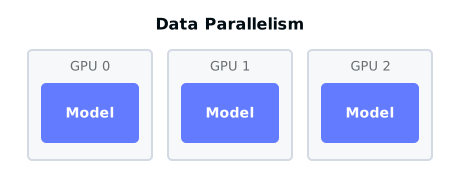
As a result, adding more replicas increases aggregate throughput and concurrency. It doesn't directly reduce the compute latency of an individual request, because that request is still processed by a single replica.
Data parallelism also provides a failure boundary. When a health check marks one replica unavailable, the router can stop sending new requests to it and use the remaining replicas. This improves availability, though the healthy replicas need spare capacity to absorb the traffic. Any in-flight request and local KV cache on the failed replica may also be lost.
A key consideration here is how to route requests. For LLM inference, requests can vary widely in prompt length, output length, and KV cache usage. GPU capacity is also expensive, so poor load distribution can leave some replicas overloaded while others sit underused. Production routers therefore often consider multiple signals when choosing a replica. For more information, see inference routing.
The main cost of data parallelism is memory duplication. Every replica needs a copy of the model weights and maintains a separate KV cache. If one copy of the model can't fit on a worker, data parallelism alone doesn't solve the problem. Combine it with tensor or pipeline parallelism.
Tensor parallelism
Tensor parallelism (TP) distributes the weights of a model across multiple GPUs to deploy large models that can't fit into the memory of a single GPU. It divides the tensors within each model layer, so every device holds a shard of a layer rather than a copy of it.
This is necessary because many modern LLMs can't fit on a single GPU, even after quantization, especially once you account for the KV cache and runtime overhead. For example, FP8 weights require roughly 1 GB per billion parameters, so a model like Llama 3.1 405B needs about 405 GB just for weights. That alone exceeds the memory of any single current GPU, so one device often can't load the model or serve it efficiently.
During operations such as matrix multiplication, each GPU holds a shard of the weight tensor and computes part of the result. The GPUs then exchange or combine intermediate results using collective communication operations such as all-reduce or all-gather, depending on how the tensors are partitioned.
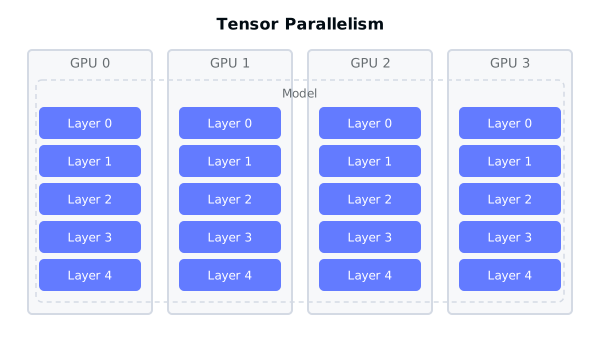
By distributing weights, cache, and computation, tensor parallelism makes models that exceed the capacity of a single GPU practical to serve. It can also lower the latency of an individual request when the gains from parallel computation outweigh the added communication cost.
That communication is the central tradeoff. GPUs in tensor parallelism must exchange intermediate results repeatedly as a request flows through the transformer layers. Interconnect bandwidth and latency therefore weigh heavily on performance.
Tensor parallelism works best among GPUs linked by high-bandwidth interconnects within a single node, such as NVLink. Splitting tensors across GPUs that sit in separate nodes can turn network communication into the dominant bottleneck. The number of GPUs you shard across is also constrained; it generally has to divide the number of attention heads evenly, so you can't scale to arbitrary GPU counts.
Before sharding a model to perform tensor parallelism, check whether the weights, KV cache, and other inference memory requirements fit comfortably on a single GPU, especially after quantization. Single-GPU serving avoids cross-device synchronization entirely, and adding GPUs through tensor parallelism rarely yields a linear speedup. Use tensor parallelism when the memory footprint or latency targets justify the communication overhead.
Pipeline parallelism
Pipeline parallelism (PP) divides the model’s layers into sequential chunks called stages, each assigned to a separate device. Data flows through these stages like an assembly line, with the output of one device becoming the input for the next. For instance, in a four-way pipeline, each device processes a quarter of the model’s layers.
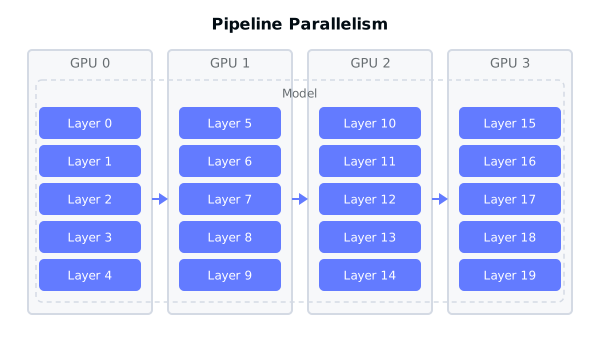
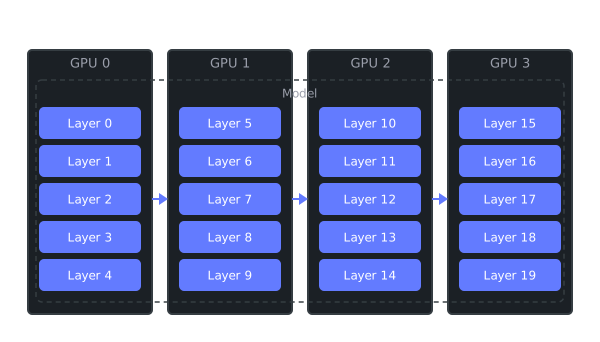
Unlike tensor parallelism, pipeline parallelism doesn't require devices to combine partial results within every layer. A stage sends activations to the next stage only after finishing all of its own layers. This lower communication frequency can make pipeline parallelism a better fit for low-bandwidth connections, including the interconnects between nodes.
The trade-off is a pipeline bubble. A stage can sit idle while waiting for work from the previous stage. A slow or memory-heavy stage can also hold up every stage that follows. Stage boundaries should therefore balance execution time and memory demand, not only the number of layers.
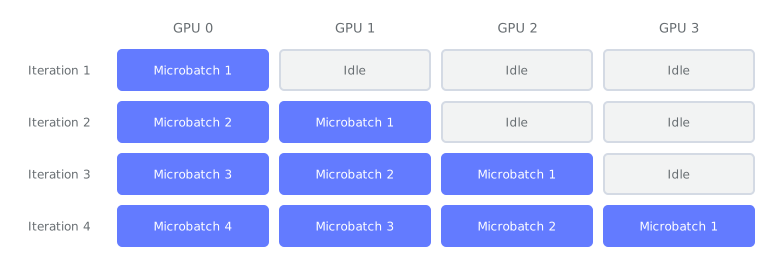
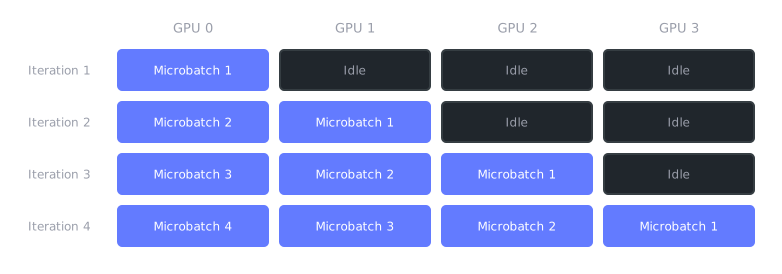
To shrink idle periods, the server can keep multiple requests or microbatches in flight. While a later stage handles one microbatch, an earlier stage can begin work on the next microbatch. This scheduling mechanism improves throughput, though it doesn't completely eliminate idle time at the start and end of the pipeline. For more information, see the GPipe paper.
Note that pipeline parallelism doesn't necessarily reduce latency for an individual request. Every request still passes through all stages in order and pays the cost of activation transfers. Pipeline parallelism works best when enough concurrent work is available to keep the pipeline full or when lower communication frequency matters more than the pipeline bubble.
Expert parallelism
Expert parallelism is a specialized parallelism strategy used in Mixture of Experts (MoE) models. In these models, only a subset of the experts is activated for each token. Instead of duplicating all experts across every device (e.g., GPU), expert parallelism splits the experts themselves across different devices.
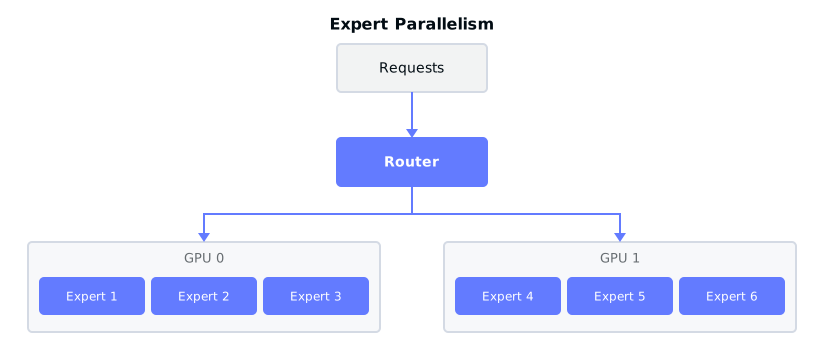
Each GPU holds the full weights of only some experts, not all. This means that each GPU processes only the tokens assigned to the experts stored on that GPU. In contrast, if you apply tensor parallelism for MoE models, it simply slices the weight matrices of all experts and distributes these slices across all devices.
By using expert parallelism, GPUs can be utilized more efficiently. This reduces memory and compute overhead compared to replicating the entire model on every device.
Hybrid parallelism
For certain models, relying on a single parallelism strategy is often not enough. Hybrid parallelism combines two or more parallelism techniques to achieve better scalability, efficiency, and hardware utilization.
Figure 6 illustrates what a typical hybrid setup might look like (when combining data parallelism and tensor parallelism).
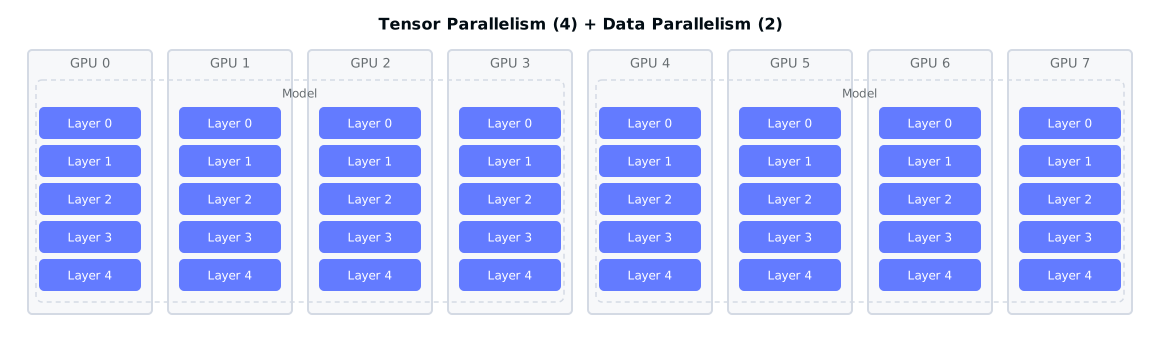
If you have 8 GPUs, you could apply tensor parallelism across the first four GPUs (TP=4), then replicate that setup to the remaining ones using data parallelism (DP=2).
Note that this is only one of the possible combinations, each with advantages and disadvantages. In figure 6, tensor parallelism introduces communication overhead between GPUs, especially during inference. Therefore, using a high TP degree doesn't always translate to better performance.
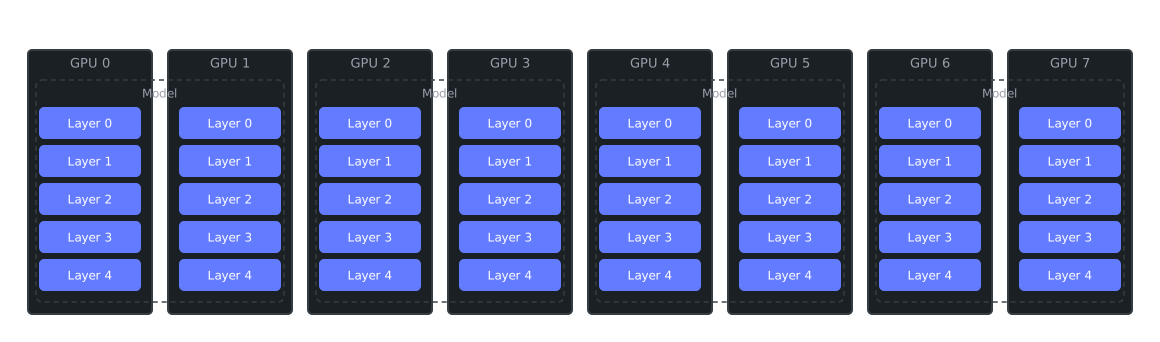
An alternative configuration is to reduce tensor parallelism and increase data parallelism. For example, you can set TP=2 and DP=4, as shown in figure 7.
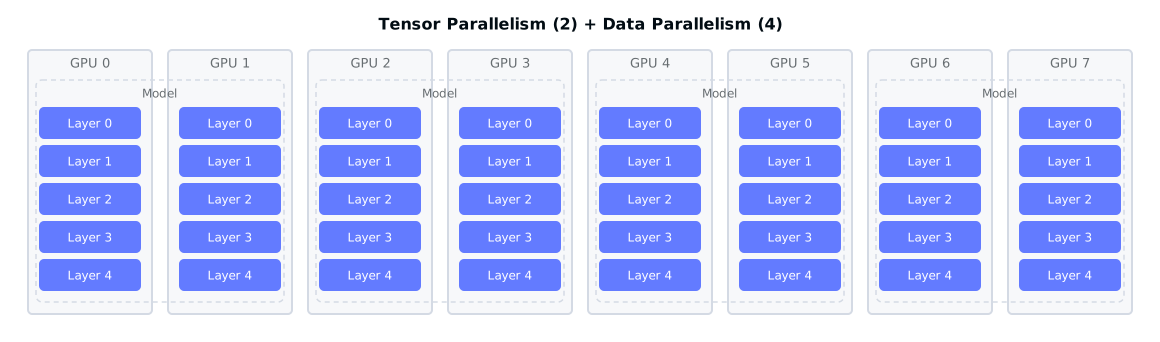
This reduces cross-GPU communication, which may help lower latency during inference. However, there’s a catch: model weights consume a large portion of GPU memory, especially for large models. Lowering tensor parallelism means fewer GPUs share the model, leaving less room for KV cache. This can degrade inference optimizations like prefix caching.
These trade-offs aren’t unique to tensor and data parallelism. When designing a hybrid parallelism plan, it’s essential to benchmark different configurations based on your specific model size, hardware setup, and inference requirements. There’s no one-size-fits-all setup. The optimal strategy is often found through tuning and experimentation.
How to configure parallelism
Inference frameworks expose these strategies as server flags. Here are some examples to serve models on multiple GPUs.
- MAX
- vLLM
- SGLang
# TP=4: one replica sharded across four GPUs
max serve --model meta-llama/Llama-3.3-70B-Instruct \
  --devices=gpu:0,1,2,3

# DP=8: eight single-GPU replicas
max serve --model meta-llama/Llama-3.1-8B-Instruct \
  --devices gpu:0,1,2,3,4,5,6,7 \
  --data-parallel-degree 8

# EP=8, DP=1: one replica, experts sharded across eight GPUs
max serve --model nvidia/DeepSeek-V3.1-NVFP4 \
  --devices gpu:0,1,2,3,4,5,6,7 \
  --data-parallel-degree 1 \
  --ep-size 8
Use --devices to select GPUs in MAX. --data-parallel-degree
must be either 1 (a single TP replica across all selected GPUs) or equal to
the GPU count (one replica per GPU). Partial layouts such as TP=4 × DP=2 on
eight GPUs are currently not supported. --ep-size must be either 1 (no
expert parallelism) or the total number of GPUs across all nodes.
# TP=4: one replica sharded across four GPUs
vllm serve --model meta-llama/Llama-3.3-70B-Instruct \
  --tensor-parallel-size 4

# TP=4, DP=2: eight GPUs split into two replicas
vllm serve --model meta-llama/Llama-3.3-70B-Instruct \
  --tensor-parallel-size 4 \
  --data-parallel-size 2

# EP: MoE layers switch from tensor to expert parallelism
vllm serve --model deepseek-ai/DeepSeek-V3 \
  --tensor-parallel-size 8 \
  --enable-expert-parallel
In vLLM, expert parallelism is a toggle rather than a degree. It routes MoE
layers over the GPUs already claimed by TP and DP. Without
--enable-expert-parallel, MoE layers would use tensor parallelism (a
TP group of size TP × DP), similar to dense models.
# TP=4: one replica sharded across four GPUs
sglang serve --model-path meta-llama/Llama-3.3-70B-Instruct \
  --tp-size 4

# TP=4, DP=2: eight GPUs split into two replicas
sglang serve --model-path meta-llama/Llama-3.3-70B-Instruct \
  --tp-size 4 \
  --dp-size 2

# EP=8: MoE experts sharded across all eight GPUs
sglang serve --model-path deepseek-ai/DeepSeek-V3 \
  --tp-size 8 \
  --ep-size 8
In SGLang, each flag also accepts a longer alias: --tensor-parallel-size,
--data-parallel-size, and --expert-parallel-size.
Whichever framework you use, benchmark the layout rather than assuming the highest degree wins.