For the complete documentation index, see llms.txt. Markdown versions of all pages are available by appending .md to any URL.
Speculative decoding
Speculative decoding is an inference-time optimization that speeds up LLM token generation without reducing output quality. It works by pairing two models:
- Draft model: A smaller, fast model proposes several draft tokens ahead.
- Target model: A larger model verifies these proposed tokens in parallel and accepts those that match its own predictions.
This draft-then-verify pattern guarantees the final output matches exactly what the original target model would have produced on its own. Therefore, it does not sacrifice output quality.
Why speculative decoding
Transformer-based LLMs generate text autoregressively: one token at a time, each depending on the previous ones. Every new token requires a full forward pass, sampling, and then appending that token to the input before the next step begins.
This sequential process has two major issues:
- High Inter-Token Latency (ITL): The delay between tokens makes generation feel slow.
- Poor GPU utilization: The model can’t compute future tokens in advance even if the GPU is idle.
What if you could parallelize parts of the generation process, even if not all of it?
Inspired by speculative execution (operations are computed ahead of time and discarded if unnecessary), speculative decoding allows parts of token generation to run in parallel. When the target model verifies multiple draft tokens at once, it makes better use of GPU resources and reduces ITL. This is especially useful for latency-sensitive applications like chatbots and code completion tools.
This technique builds on two key observations about LLM inference:
- LLM inference is memory-bound. GPUs have massive compute capacity but limited memory bandwidth. Much of their compute sits unused while waiting on memory access.
- Some tokens are easier to predict than others. Many next tokens are obvious from context and can be proposed by a smaller model.
The draft-then-verify idea was first introduced by Stern et al. (2018), and later extended by DeepMind into a statistically grounded method called Speculative Sampling. Speculative decoding is the application of speculative sampling to inference from autoregressive models, like transformers.
How does speculative decoding work
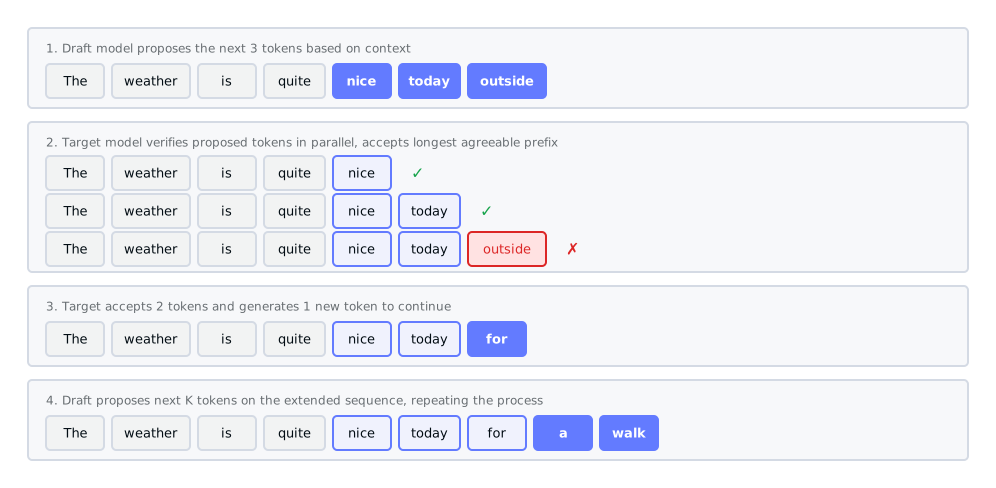
At a high level, speculative decoding runs in a loop:
- The draft model predicts the next K tokens after the input sequence.
- The target model then verifies these K tokens in parallel to see if it would also predict them.
- The target model accepts the longest prefix of these K tokens that it agrees with.
- If it accepts h tokens, it then generates the *(h+1)*th token itself (so that generation remains on track).
- The process repeats: the draft model proposes the next K tokens based on this new extended sequence.
Understanding the performance of speculative decoding
Speculative decoding can accelerate LLM inference, but only when the draft and target models align well. Before enabling it in production, always benchmark performance under your workload. For a quick test, you can choose inference frameworks like vLLM, SGLang, and MAX, which provide built-in support for this inference optimization technique.
Key metrics
When evaluating speculative decoding, three metrics matter most:
-
Acceptance rate (α): The probability of accepting draft tokens by the target model. This figure varies by several factors like decoding strategy (e.g., nucleus vs. random sampling) and application domain.
A high α value means more tokens are accepted per round and you have fewer target model forward passes. This results in lower latency, higher throughput, and better GPU utilization. On the contrary, a low α indicates many tokens are rejected. This means you waste compute on drafting and verification. It also means reverting to sequential decoding more frequently.
-
Speculative token count (γ): The number of tokens the draft model proposes each step. It is configurable in most inference frameworks.
-
Acceptance length (τ): The average number of tokens accepted per round of decoding. According to the paper Fast Inference from Transformers via Speculative Decoding, you can calculate it with a theoretical formula:
How acceptance rate impacts performance
In theory, the effectiveness of speculative decoding depends heavily on
acceptance rate. To isolate this variable, you can simulate speculation by
accepting each drafted token at a preset probability instead of running a real
draft model. For example, a
BentoML benchmark
used a patched vLLM setup for this purpose;
Modular MAX supports speculative decoding
and exposes a --synthetic-acceptance-rate knob for the same kind of controlled
test.
The simulated benchmark showed four patterns:
- Higher α produces greater speedup.
- Increasing γ helps only when τ is high; otherwise, performance may be negatively affected.
- Latency drops and throughput rises almost linearly with α.
- At α ≥ 0.6 and γ ≥ 5, speculative decoding achieved 2–3× speedups over baseline decoding.
In practice, however, the speedup was lower than expected.
How performance varies under different workloads
The synthetic acceptance-rate test isolates the effect of α and γ, but real deployments also have to contend with concurrency and parallelism. To see how those factors interact, a separate set of benchmarks measured speculative decoding under different concurrency levels and tensor parallelism (TP) configurations, serving Llama-3.3-70B-Instruct with vLLM on H100 GPUs.
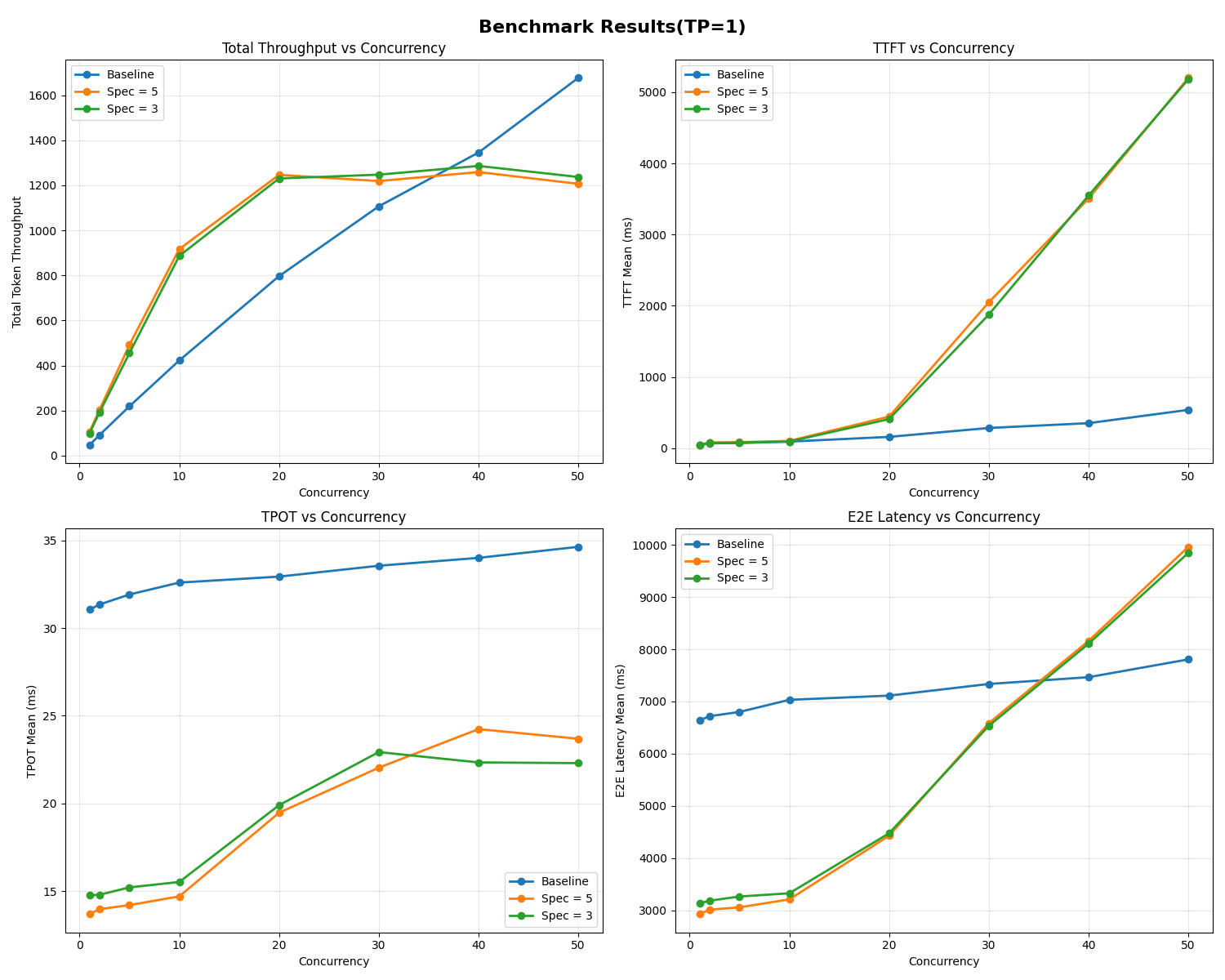
With TP = 1, the total throughput plateaued earlier (around 20–30 concurrent requests) compared to the baseline. This indicates that the coordination between the draft and target models might bring overhead at higher loads. Still, Time Per Output Token (TPOT) improved by roughly 2×.
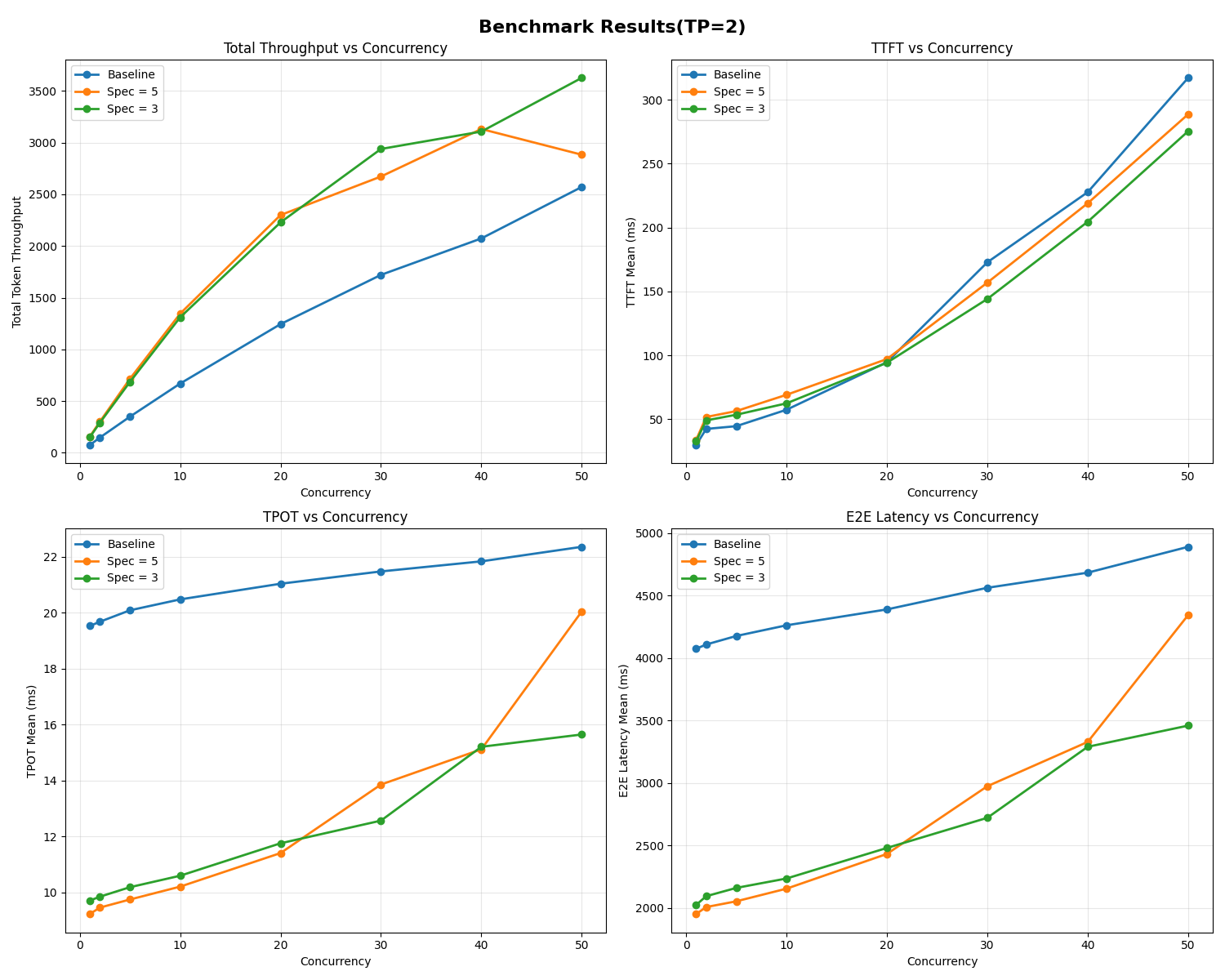
With TP = 2, the performance of speculative decoding improved, showing clear throughput gains over baseline. However, a higher speculative token count (γ = 5) saw larger latency spikes under heavy concurrency (40+ requests).
Overall, the results show that speculative decoding reduced TPOT across different workloads. Adding parallelism (TP = 2) improves throughput, but you need to tune γ to avoid latency spikes at high load.
Tips for using speculative decoding
Speculative decoding can deliver real gains, but only if you set it up carefully. The trick is knowing where it helps most and where it might backfire.
Watch out for memory overhead
You need to load both the draft model and the target model into GPU memory. On a single GPU, it can quickly squeeze out space for other tasks (e.g., batch processing) and hurt performance under heavy load or with larger models.
For a multi-GPU setup (e.g., TP > 1), the story is different. Splitting models across multiple GPUs reduces the bottleneck. In the tests above, speculative decoding with γ = 3 or γ = 5 kept outperforming baseline even at 50 concurrent requests.
Don’t ignore wasted compute
When the target model rejects too many draft tokens, your GPU still spends time generating and verifying them. The work doesn’t pay off and it defeats the point of speculative acceleration. It is also why acceptance rate matters so much.
Get the draft model right
How closely your draft model’s distribution matches with the target model determines the acceptance rate. Out-of-the-box draft models may work fine in some cases, but they often struggle with domain-specific tasks or very long contexts.
If your workload has its own characteristics, you’ll likely get better results by fine-tuning a draft model on your data. That way, it learns to mimic the target more closely, boosting acceptance rates and speedups. On the flip side, if you already see good acceptance, you can skip the training and still benefit.
Speculative decoding methods
The draft-then-verify pattern above describes the classic setup, where a separate, smaller model does the drafting. However, it is only one way to generate draft tokens. Over time, researchers have developed a number of methods that differ mainly in how the draft tokens are proposed.
Broadly, the approaches fall into four groups:
- Standalone draft model. A separate smaller model proposes tokens (the classic one described above).
- Target-specific auxiliary drafter. A lightweight model trained specifically for the target proposes tokens or hidden features. EAGLE, DFlash, and DSpark belong to this group and require target-specific draft weights, which may be packaged separately or bundled with the target checkpoint.
- Model-integrated drafter. Extra prediction heads or modules are included in the target checkpoint, as with Medusa or native MTP models.
- Training-free or retrieval-based methods. Candidates are generated algorithmically or retrieved from the prompt and previously generated context, without a trained draft component.
Let’s take a look at them in more detail.
Medusa
Medusa removes the separate draft model. It attaches several lightweight decoding heads on top of the target model's final hidden state. Each head predicts a token at a future position (t+2, t+3, t+4, …), while the original LM head of the model still handles the immediate next token (t+1).
The top candidates from these heads are combined into a tree of possible continuations. The target model then evaluates the tree in one forward pass using tree attention, which applies an attention mask that preserves the causal relationships within each candidate branch. Similar to the classic speculative decoding method, the longest accepted candidate prefix will be used for the next decoding phase.
Medusa comes in two flavors:
- Medusa-1 trains only the new heads on a frozen backbone LLM, leaving the backbone weights unchanged. The paper reports speedups above 2.2× without compromising generation quality.
- Medusa-2 fine-tunes the heads and backbone together. This improves draft accuracy but modifies the original target model. The paper reports speedups of approximately 2.3–3.6× by using a training recipe that preserves the capabilities of the backbone LLM.
Multi-Token Prediction (MTP)
Multi-Token Prediction started as a training objective: instead of only predicting the next token, the model is trained to predict several future tokens at once. This gives the model denser training signal and, as a side benefit, built-in machinery for drafting.
DeepSeek-V3 popularized MTP at scale, using sequential MTP modules that preserve the full causal chain at each prediction depth. At inference time, these MTP modules can be repurposed as native draft heads for speculative decoding, so the model speculates on its own next tokens with no separate draft model and no bolt-on heads. Because the MTP modules are trained jointly with the main model, their predictions align closely with the target distribution, which tends to yield high acceptance rates.
N-gram speculation
N-gram speculation generates draft tokens without running a separate draft model or adding trained prediction heads. It searches the existing context for repeated token sequences and reuses the continuation that followed an earlier match.
A typical implementation follows four steps:
- Take a suffix from the current sequence, such as the most recent two, three, or four tokens.
- Search the prompt or previously generated text for an earlier occurrence of that suffix.
- Copy the tokens that followed the earlier occurrence and use them as a draft.
- Ask the target model to verify the proposed tokens.
N-gram speculation is helpful when the desired output repeats or closely follows language already available in the prompt. Common examples include:
- Summarizing or rewriting supplied text
- Editing code or configuration files
- Filling predefined templates
- Answering questions from retrieved documents
- Reproducing names, dates, identifiers, or technical terms from the input
- Generating structured output from a schema or example already included in the prompt
EAGLE
EAGLE (Extrapolation Algorithm for Greater Language-model Efficiency) makes a key observation: autoregression is easier to model at the feature level (the hidden states of the second-to-top layer) than at the token level. So instead of predicting the next token, the lightweight EAGLE draft model predicts the next feature, then reuses the LM head of the target model to turn that feature into token probabilities.
Under stochastic sampling, the current feature does not reveal which token was
sampled from the corresponding distribution. For example, if the generated text
currently ends with I, sampling might produce am, always, or think. The
next feature depends on the token actually drawn: I am and I always lead to
different hidden states.
The fix from EAGLE is simple: tell it. Along with the features, feed in the tokens that were actually sampled, offset by one position so that each feature is paired with the token that came after it. This way, at each step the draft head sees "here's the hidden state, and here's the token that the sampler actually picked from it", which is exactly the missing information needed to know where the sequence went.
EAGLE has evolved across three versions:
- EAGLE-1: Feature-level autoregression with a small draft model.
- EAGLE-2: Adds a context-aware dynamic draft tree. It uses the confidence scores from the draft model to allocate candidate branches to positions where acceptance is more likely. The paper reports speedups of approximately 3.05–4.26× in evaluations.
- EAGLE-3: Drops the feature-prediction constraint and predicts tokens directly. It fuses low-, mid-, and high-level features from the target model. The paper reports speedups of approximately 3.0×–6.5× over vanilla autoregressive generation across the evaluated models and tasks.
EAGLE is widely adopted and supported natively in frameworks like vLLM, MAX, and SGLang. The EAGLE papers report strong speedups, but actual gains depend on the target model, draft checkpoint, workload, hardware, and serving implementation.
DFlash
DFlash is a speculative decoding method that uses a lightweight block diffusion model as the drafter. Instead of predicting one token and looping, it fills in a block of masked positions in parallel and drafts all of them in a single forward pass.
This matters because drafting is the sequential part of speculative decoding. EAGLE and the classic draft model generate tokens one at a time, so γ draft tokens cost γ forward passes. Each step is cheap, but the chain still caps how much speculation you can fit into one verification round. DFlash drafts the whole block in one pass, so drafting cost no longer grows step by step with the number of draft tokens.
DFlash borrows the parallel generation mechanism of diffusion LLMs, but applies it block by block rather than to the whole response, and only for drafting. The target model stays autoregressive and verifies every token.
To keep those parallel drafts accurate, the drafter conditions on the target model. Hidden states from a fixed set of target layers (sampled from shallow to deep) are injected directly into the key and value projections of every draft layer. Therefore, each draft position attends over rich target features rather than just previous tokens. Verification is unchanged, so the output is still lossless.
The DFlash paper reports over 6× lossless acceleration on Qwen3-8B and an average of 4.9× over the autoregressive baseline across the evaluated models, up to 2.5× higher than EAGLE-3, with the largest gains on math and coding tasks. DFlash drafters are available for a range of open models, and major inference frameworks like vLLM, SGLang and MAX all support it.
DSpark
DSpark is a speculative decoding method from DeepSeek that builds on DFlash-style parallel drafting. It adds a lightweight sequential correction to the draft block and decides how much of each block is actually worth verifying.
Both changes target a weakness of parallel drafters like DFlash, which the DSpark authors call suffix decay or acceptance decay. Because the draft tokens in a block are generated independently, not autoregressively, acceptance drops off quickly for later positions in the block.
Decay looks like this. Suppose the user sends "Thanks!" to the model. The model could reply either "Of course" or "No problem". A parallel drafter picks both words at the same time:
- The first word is either "Of" or "No".
- The second word is either "course" or "problem". The drafter picks one without knowing which first word was chosen.
Each word makes sense on its own, but together they can come out as "Of problem" or "No course". The target model rejects this mismatch. The paper calls this type of problem a multi-modal collision. It gets worse deeper into the block: each later position has more unresolved earlier choices it can't see.
Verifying those low-value tail tokens is wasted work, and under heavy load it competes with batch capacity that could serve other requests.
DSpark addresses this with two complementary mechanisms:
- Semi-autoregressive drafting. DSpark keeps a DFlash-style parallel backbone (sharing the frozen embedding layer and LM head of the target), but adds a lightweight sequential head. It walks left to right and adjusts each position based on what was actually picked just before it. In the above example, once "Of" is chosen, it boosts "course" and suppresses "problem".
- Confidence-scheduled verification. DSpark uses a lightweight confidence head to estimate the acceptance probability of each drafted token, conditioned on the preceding draft prefix being accepted. Multiplying these per-position probabilities gives the estimated probability that a prefix of a given length will survive verification. A hardware-aware scheduler then balances these survival probabilities against profiled engine throughput and verification cost. This enables DSpark to dynamically choose how much of each draft block is worth verifying.
DSpark is effectively a built-in form of adaptive speculative decoding. The DSpark paper reports 16–18% longer accepted lengths than DFlash and 27–31% longer than EAGLE-3 on Qwen3 models, and 60–85% faster per-user generation at matched throughput versus an MTP-1 baseline in production on DeepSeek-V4-Flash. Major inference frameworks like vLLM, SGLang and MAX support DSpark.
Choosing a method
There's no universally best method. The right choice depends on your needs:
| Method | Extra draft model | Training required | Note |
|---|---|---|---|
| Vanilla speculative decoding | Yes | No (optional fine-tuning) | Matching a good draft model can be tricky |
| Medusa | No (extra heads) | Yes (heads) | Moderate speedup |
| MTP | No | Yes (jointly, at pretraining) | Models trained with MTP (e.g., DeepSeek-V3) |
| N-gram | No | No | Zero-setup gains, input-grounded tasks |
| EAGLE | Yes | Yes (draft model) | Strong reported speedups, broad framework support |
| DFlash | Yes | Yes (draft model) | Parallel block drafting in one forward pass |
| DSpark | Yes | Yes (draft model) | Parallel drafting plus confidence-scheduled verification |
Inference frameworks like vLLM, MAX, and SGLang implement several of these methods, so you can benchmark them against your own workload before committing.
Adaptive speculative decoding
Most speculative decoding deployments use a fixed speculative token count or number of draft steps (γ). It may work for a benchmark, but it is rarely optimal for every request in production.
Real workloads are dynamic. The predictability of the next token changes throughout generation, and batch sizes fluctuate as requests enter and leave the system. A large speculative window can work well when the draft model is highly accurate and batch sizes are small. The same window may become inefficient when acceptance rates fall or batch sizes grow, because every unnecessary draft step consumes additional compute across more sequences.
A fixed γ is therefore a compromise. It may be too conservative when the GPU has spare capacity and could benefit from more aggressive drafting, and too aggressive when the system is busy and rejected draft tokens become wasted work.
Adaptive speculative decoding addresses this problem by adjusting speculative decoding parameters at runtime instead of relying on a single configuration. The goal is to keep speculation aligned with current conditions.
What can be adaptive?
Adaptive speculative decoding can modify one or more aspects of the speculation process.
- Speculative length. How many tokens the draft model proposes before handing off to the target for verification. Tuning this is the most common and lowest-risk form of adaptivity. It changes speed only, and the output remains identical to what the target would have produced (lossless). For example, the system may increase speculative length when acceptance rates are high and resources are available, then reduce it when acceptance rates decline or the system becomes saturated.
- Acceptance criterion. How strictly the target verifies each draft token. Relaxing verification lets more "close enough" tokens through, which accelerates generation but allows the output to drift from the exact distribution by the target model (lossy). This trades a small amount of quality for additional speed and should be used deliberately.
Existing solutions
Adaptive speculative decoding is an active area, and current solutions span a spectrum from production-ready features to research prototypes.
SGLang adaptive speculative decoding
SGLang provides a built-in adaptive speculative decoding mechanism that dynamically adjusts speculative length during inference.
After each verification round, SGLang measures the number of accepted draft
tokens and maintains an exponential moving average (EMA) of the accepted length.
Based on this value, it switches between a small set of predefined
speculative-length tiers (for example, [1, 3, 7] by default).
Each tier has its own pre-captured CUDA graph, so switching between tiers is inexpensive and does not require graph recapture. The method is reactive, batch-level, and lossless because it only adjusts speculative length and preserves the original verification algorithm.
AdaSpec
AdaSpec is a research LLM inference system built on vLLM that takes a more sophisticated, predictive approach. It attempts to predict the efficiency of different speculative lengths before drafting begins.
AdaSpec uses draft-model confidence scores to estimate acceptance rates and combines those estimates with a performance model that accounts for factors such as batch size and context length. It then selects a speculative configuration that maximizes performance while maintaining service-level objectives (SLOs), such as TPOT targets.
The authors report that AdaSpec consistently achieves high SLO attainment and delivers up to 66% speedup compared to prior speculative serving systems on real-world serving traces.
AdaSD
AdaSD is a research decoding algorithm designed primarily for off-the-shelf draft and target model pairs. Unlike most adaptive approaches, AdaSD adapts both speculative length and the acceptance criterion. It introduces two dynamically adjusted thresholds derived from runtime statistics:
- Draft-token entropy determines when the draft model should stop generating additional speculative tokens.
- Jensen–Shannon (JS) distance between the draft and target distributions determines whether a draft token is sufficiently close to the target distribution to be accepted.
Because AdaSD can accept tokens that don't strictly satisfy the original speculative decoding acceptance rule, it is a lossy approach. The authors report up to 1.46× speedup over vanilla speculative decoding while limiting accuracy degradation to less than 1.8% on their benchmarks.
AdaSD requires the draft and target models to share the same vocabulary. This is because entropy and JS-distance calculations operate directly on the token probability distributions produced by the two models. If the vocabularies differ, these distributions cannot be compared consistently.
When is adaptive speculative decoding worth it?
Adaptive speculative decoding is most useful when serving conditions vary significantly over time. Examples include bursty traffic patterns, rapidly changing batch sizes, mixed workloads, or applications where acceptance rates swing widely.
In those cases, dynamically adapting to current conditions often outperforms any single fixed speculative length. On the other hand, if your workload is stable and you have already tuned a static γ for your model and hardware, adaptive mechanisms may provide only marginal benefits.
As with speculative decoding in general, the only reliable way to know is to benchmark under your own model, hardware, and workload before applying it in production.
Additional resources
- Looking back at speculative decoding
- Adaptive Speculative Decoding in SGLang
- AdaSpec: Adaptive Speculative Decoding for Fast, SLO-Aware Large Language Model Serving
- AdaSD: Adaptive Speculative Decoding for Efficient Language Model Inference
- EAGLE: Speculative Sampling Requires Rethinking Feature Uncertainty
- DFlash: Block Diffusion for Flash Speculative Decoding
- DSpark: Confidence-Scheduled Speculative Decoding with Semi-Autoregressive Generation
- Fast Inference from Transformers via Speculative Decoding
- Accelerating Large Language Model Decoding with Speculative Sampling