For the complete documentation index, see llms.txt. Markdown versions of all pages are available by appending .md to any URL.
What is LLM inference infrastructure?
LLM infrastructure is the set of hardware, software, and operational practices used to train, fine-tune, evaluate, and serve LLMs.
This page focuses on LLM inference infrastructure: the part that runs trained models in production. It includes the GPUs that execute the model, the runtime that generates tokens, and the systems for deployment, scaling, routing, and monitoring. Together, they keep models available as traffic changes and help you meet your latency, throughput, and cost targets.
Why general-purpose cloud stacks fall short
Standard cloud-native infrastructure was designed for stateless CPU services. Serving LLMs breaks that model in several ways:
- GPUs can’t be shared the way CPUs can. A container can’t take "half a GPU" for a burst. A model with multi-gigabyte weights either fits on the device or it doesn’t. Idle GPUs are expensive, so over-provisioning to avoid cold starts raises costs.
- Replicas are stateful. Each replica holds a memory-heavy KV cache for active requests. With prefix caching, replicas can retain cache for reuse across requests, so which replica handles a request affects latency. Round-robin load balancing can miss reusable prefixes on other replicas.
- Requests aren’t uniform. Work depends on prompt and output length, and one request may generate 20 tokens while another generates 4,000. Counting requests per second tells you little about actual GPU load.
- Startup is slow. LLM containers are large. Image pulls and weight loading make reactive autoscaling arrive after the traffic spike has already caused timeouts, and users notice because they’re waiting on a response in real time.
These gaps are why LLM inference needs a purpose-built stack.
The LLM inference stack
The requirements above determine how the layers of the inference stack work together. The sections below cover each part of the stack at a high level, with links to related handbook pages.
Compute hardware
The hardware layer mainly includes GPUs and other accelerators, memory, interconnects, and storage. LLM inference, especially the decode phase, is bound by memory capacity and bandwidth more than raw FLOPS. The key hardware questions are how much high-bandwidth memory (HBM) each device has and how fast devices can talk to each other.
Here are two examples to show why memory is the limiting factor:
- Llama 3.1 70B in BF16 needs about 140 GB just for weights. A single NVIDIA H100 has 80 GB of HBM, so the model must be split across at least two H100 GPUs before any request is served.
- The KV cache for the same 70B model uses roughly 320 KB per token. At a 128K-token context, one request can hold about 40 GB of cache on top of the weights.
Because models are split across GPUs, interconnect bandwidth also becomes a serving bottleneck.
When choosing GPUs for your model size and latency target, consider:
- Whether to run on-prem, in your own cloud account with BYOC, or on a managed platform.
- How to source GPUs across regions and providers when a single region can’t meet demand, especially during traffic peaks.
Serving runtime
The serving runtime, also called the inference engine or inference framework, is the software that loads model weights onto GPUs, accepts requests, and generates tokens. Examples include vLLM, SGLang, and MAX.
The runtime determines how efficiently each GPU serves requests. Runtimes differ in which optimization techniques they support and how well they implement them, such as continuous batching, PagedAttention, prefix caching, quantization, speculative decoding, and parallelism.
For more information, see choosing the right inference framework.
Model packaging and deployment
This layer turns model weights into a deployable artifact. It includes the container image, the model files, any fine-tuned adapters, the runtime configuration, and the serving code that wraps the model in an API.
Packaging choices affect cold-start time. LLM container images are large, and model weights can run from tens of gigabytes to over a terabyte for trillion-parameter models. This means pulling an image and loading weights onto a fresh node can take a long time before the first request is served. Decisions made here (e.g., whether weights ship inside the image or stream from object storage) determine how quickly the orchestration layer can add capacity.
Orchestration and scaling
The orchestration layer decides how many replicas run, where they run, and when to add or remove them. In most production deployments this is Kubernetes plus a GPU-aware autoscaler.
LLM workloads don’t fit the assumptions behind standard autoscaling. Cold starts are a good example: provisioning a GPU node, pulling the image, and loading weights can take a long time. Capacity added in reaction to a traffic spike often arrives after the spike has already caused timeouts. The usual scaling signals don’t help either: CPU utilization says little about a GPU-bound workload, and GPU utilization reports a device as busy even when it has room for a larger batch. Neither reliably tells the autoscaler when to add capacity.
Placement is another example. A single replica may span several GPUs or nodes, and with prefill-decode disaggregation the prefill and decode phases of a request run on separate GPU pools that scale independently. The orchestrator has to place these pools with the right interconnect between them, keep KV cache transfer fast, and scale each pool on the right signal.
For more information, see the following sections:
- Fast scaling explains the cold-start problem and which metrics to scale on.
- Distributed inference covers running one model across multiple GPUs, nodes, and regions.
- Multi-cloud and cross-region inference covers placing capacity across providers for availability, compliance, and cost.
Gateway and routing
The gateway is the entry point for application traffic. It exposes an API (usually an OpenAI-compatible or Anthropic-compatible endpoint), enforces authentication and rate limits, and decides which replica should handle each request.
Routing decisions can affect how much work the model needs to do. Because each replica holds KV cache state, sending a request to a replica with a matching prompt prefix in cache can avoid recomputing thousands of prompt tokens. Inference routing covers prefix-aware, cache-aware, and prefill/decode-aware routing strategies. When an application chains several models together, the gateway may also coordinate multi-model inference pipelines.
Observability
Observability collects metrics, logs, traces, and events across the stack so you can see what the system is doing and why. General application metrics such as request rate and error rate still matter, but LLM inference requires metrics that standard dashboards don’t track:
- Time to first token (TTFT) and inter-token latency (ITL)
- Tokens per second, per replica and per request
- Queue wait time and in-flight request count
- KV cache utilization and prefix-cache hit rate
- GPU memory usage and out-of-memory events
Without these measurements, diagnosing low GPU utilization or rising TTFT becomes guesswork. See LLM inference metrics for more information about the key latency and throughput metrics.
The observability layer should also support cost-to-serve management, which teams often overlook until the GPU bill arrives. It means tracking the cost of each workload and tuning model choice, hardware, batching, routing, and scaling policies to meet cost targets. This is important because inference cost is ongoing and grows with token usage or provisioned GPU capacity. A model that’s affordable at launch can become the largest line item once traffic grows. Without per-workload cost data, you can’t tell which model, tenant, or scaling policy is responsible.
For more information, see LLM observability.
Inference operations
Inference operations keep the stack running as models, traffic, and teams change. These practices include CI/CD for model releases, canary and blue-green rollouts, automatic rollback, access control, cost attribution, and cleanup of idle GPUs.
These workflows help a deployment remain reliable through repeated model updates. InferenceOps and management describes the workflows, and inference cost covers what it takes to staff and sustain them.
Security and compliance
Security and compliance apply across the stack. Alongside standard application controls, each layer has LLM-specific responsibilities:
- Gateway: authentication, per-tenant rate limits, and input and output filtering for prompt injection, jailbreaks, and leaked secrets.
- Orchestration: placing replicas in regions that satisfy data residency and cross-border transfer rules such as GDPR, and isolating tenants at the cluster or node level.
- Packaging and runtime: controlling who can access model weights, adapters, and fine-tuning data, and verifying artifact provenance before deployment.
- Observability: logging prompts and outputs for debugging without storing sensitive data longer than policy allows.
- Operations: role-based access control for production models, audit logs for every deployment, and approval workflows for model changes.
Teams often choose self-hosting to keep prompts and data inside their own environment. Every layer needs controls that maintain that boundary.
Inference infrastructure solutions: build, buy, or both
There are three common ways to provision inference infrastructure.
| Approach | What you manage | Best for | Trade-off |
|---|---|---|---|
| Serverless LLM APIs | Nothing below the API call | Prototypes, low or spiky volume, proprietary frontier models | Per-token cost at scale, limited control, data leaves your VPC |
| Managed inference platform | Models and application code; platform runs the stack | Teams that self-host open models but don’t want to staff every layer | Platform fit and pricing; some layers are opinionated |
| Self-built on Kubernetes | Every layer | Teams with strong infrastructure engineering and strict customization needs | Highest engineering and maintenance cost, slowest time to production |
Another way to see the difference is to map each approach onto the inference stack. The more layers you manage yourself, the more control you get and the more engineering you take on.
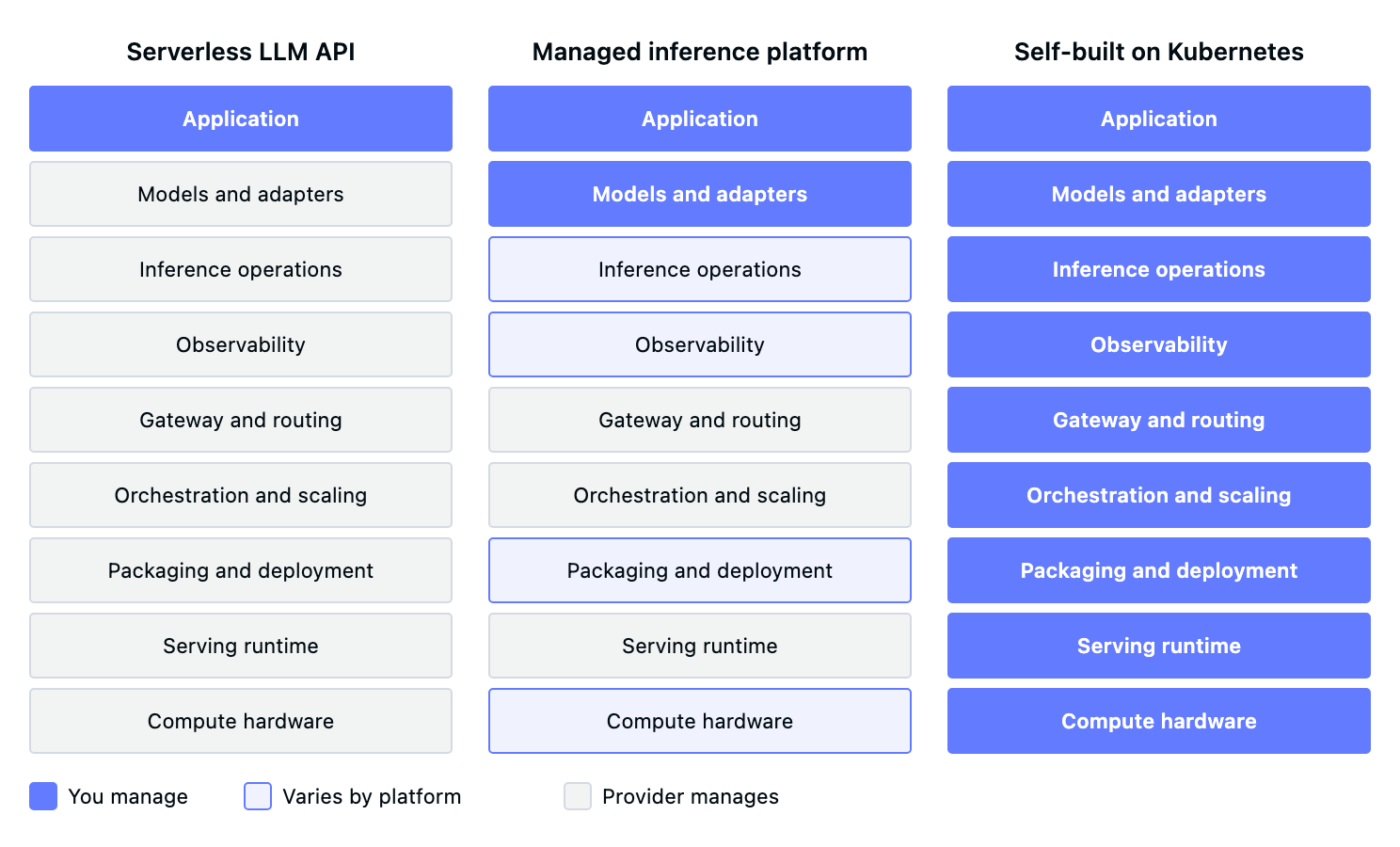
Figure 1. Which layers of the inference stack you manage under each approach.
The decision usually comes down to volume, control, and staffing. The sections below describe what each approach looks like in practice.
Serverless LLM APIs
You send requests to a hosted endpoint and pay per token. The provider picks the hardware, runs the serving runtime, and scales capacity, so you never see the stack. This category includes proprietary model APIs such as OpenAI and Anthropic, as well as serverless endpoints for open models from providers such as Together AI and Fireworks AI. It’s often the fastest way to start, but can cost more than a well-utilized dedicated deployment at high, steady volume.
For a full comparison, see serverless vs. self-hosted LLM inference.
Managed inference platforms
You bring your own model weights and application code, and the platform runs the serving runtime, routing, scaling, and observability for you. Note that a platform isn’t the same as a serving runtime such as vLLM or MAX. The platform runs a runtime on your behalf, along with the layers around it.
Managed inference platforms usually come in two forms.
- With a hosted platform, the provider supplies the GPUs and your requests and data go to them, as with dedicated deployments from Fireworks AI or Together AI.
- With a BYOC platform, the provider manages GPUs inside your own cloud account, so cloud infrastructure stays with you while the platform still handles the stack.
Self-built on Kubernetes
You assemble every layer yourself: GPU nodes, an open serving runtime such as vLLM, SGLang, or MAX, an autoscaler, a router, observability, and release tooling. This gives you maximum control and is the usual choice for teams with customization needs that no platform meets. It also carries the most engineering and ongoing maintenance work. Inference cost covers what that work involves.
FAQs
Do I need my own LLM infrastructure, or can I just use an API?
Start with an API if your volume is low and your data can leave your environment. Move to your own infrastructure when token costs at scale exceed the cost of running open models, when compliance rules apply, or when you need control over latency and customization. Many teams run both: APIs for some workloads and self-hosted models for others.
Can I run LLM inference on my existing Kubernetes cluster?
Yes, and most self-hosted deployments do. Kubernetes handles the generic parts well: scheduling Pods onto GPU nodes, rolling out new versions, and restarting failed replicas. What it doesn’t provide is anything LLM-aware. You still need to add an autoscaler that scales on request concurrency rather than CPU, a router that understands KV cache locality instead of simply balancing round-robin, and a fast path for loading model weights onto new nodes. Those pieces are where most of the engineering effort goes.